



Modular Container Camp Housing Design For Mining Site Accommodate More Than 600 Workers
Management housing: 50 single-occupancy rooms
Worker housing: 600 workers → 300 double-occupancy rooms
Total required modules: 50 (single) + 300 (double) = 350 modules
Maximum building height: 3 stories
Module dimensions:
Width: 2.438 m, Length: 6.000 m, Height: 2.700 m
Product Introduction
Modular Container Camp Housing Design for Mining Site
Introduction
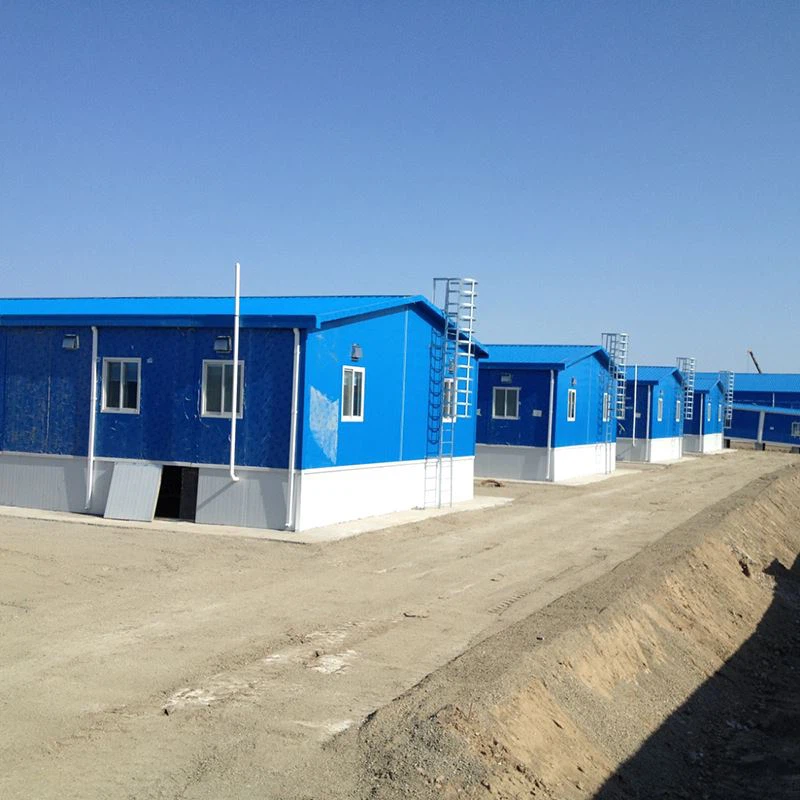
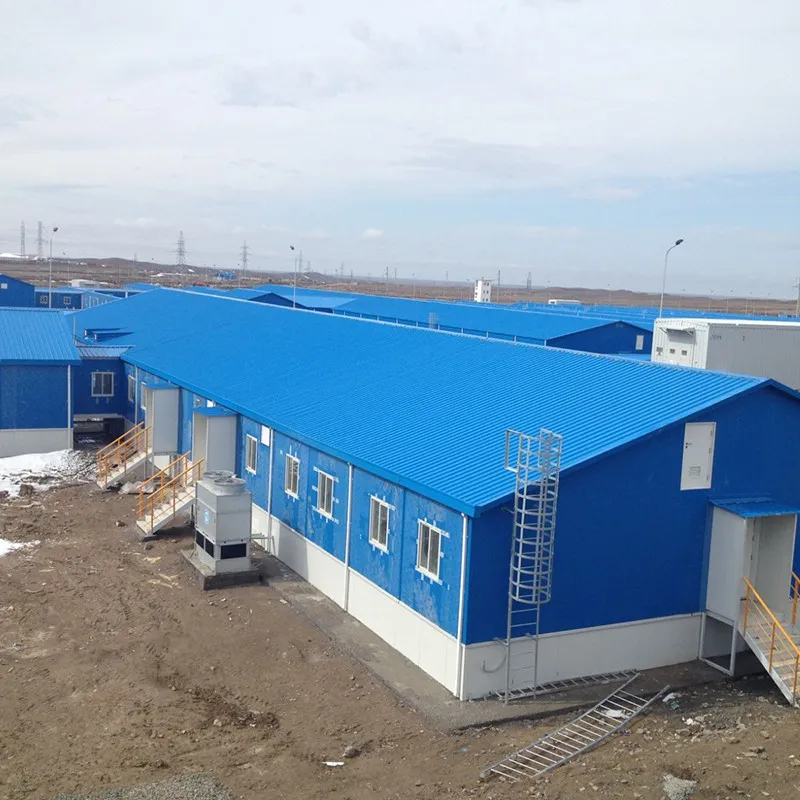
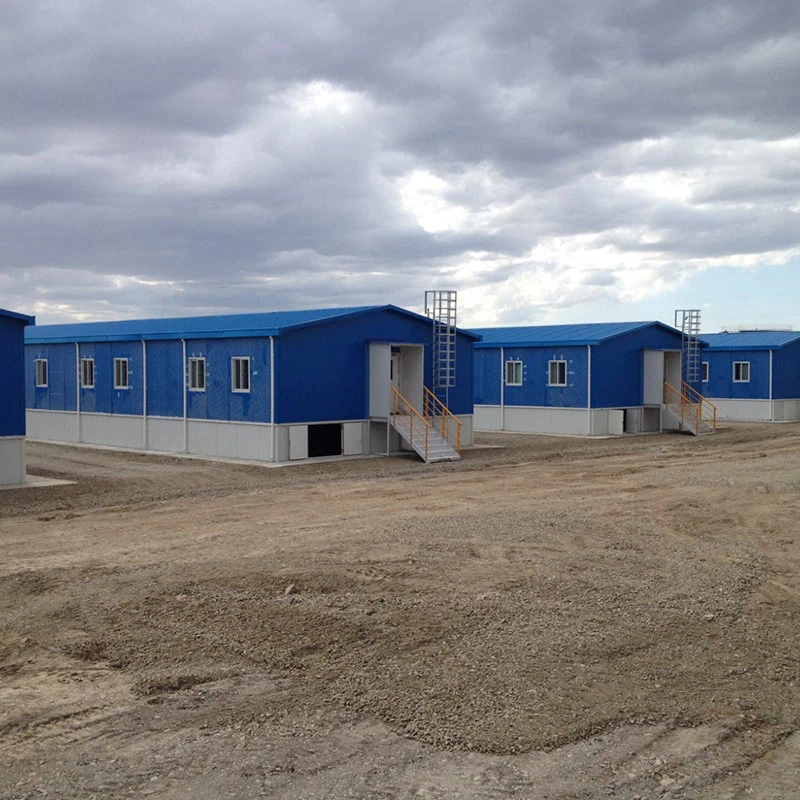
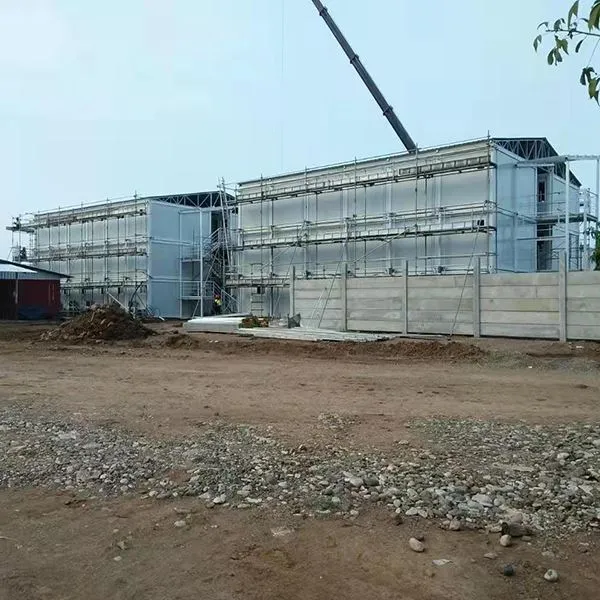
This outlines a detailed design(customized by CBC) proposal for a modular container camp housing project at a mining site. The design aims to accommodate 50 single rooms for management personnel and 600 workers (300 double-occupancy rooms) within a three-story structure featuring long-side connected modules with doors on short ends, facing each other across a central corridor. The design incorporates light steel roofing and efficient circulation systems.
Project Requirements Summary
Management housing: 50 single-occupancy rooms
Worker housing: 600 workers → 300 double-occupancy rooms
Total required modules: 50 (single) + 300 (double) = 350 modules
Maximum building height: 3 stories
Module dimensions:
Width: 2.438 m
Length: 6.000 m
Height: 2.700 m
Each module includes:
Integrated roof and prefabricated floor
4 corner posts
Wall panels:
Long sides (2 sides): 5 panels each → 10 panels
Short sides (2 sides): 2 panels each → 4 panels
Total wall panels per module: 14 panels (75 mm thick sandwich panels)
Windows and doors pre-installed in wall panels
Integrated bathroom suitable for 1–2 occupants
Design Rationale
The customized design focuses on maximizing space efficiency, ensuring safety and comfort, and facilitating rapid deployment and scalability. By aligning modules along their long sides (6 m), the layout achieves a more compact footprint, shorter corridors for better egress, and a unified appearance with a light steel roof covering.
Design Advantages
Efficient Space Utilization: Shorter corridors reduce walking distances and improve access.
Safety and Supervision: Central corridor ensures direct visibility and control.
Rapid Deployment: Prefabricated modules and standardized construction methods allow for quick assembly.
Scalability: Design can be easily replicated to expand capacity as needed.
Overall Dimensions and Layout
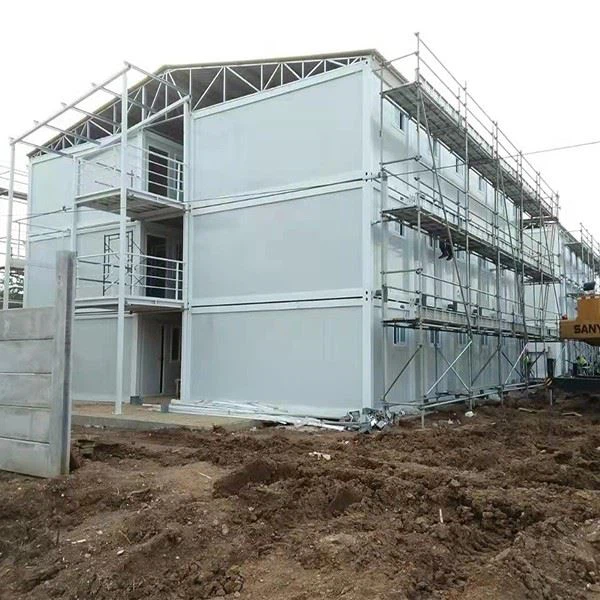
Each block consists of two parallel rows of containers, with doors facing each other across a central corridor. Key dimensions include:
Length: 48.76 m
Depth: 13.8 m
Height: ~8.7 m
Total floor area per block is approximately 2,019 m², with three blocks totaling about 6,057 m².
Material Takeoff
Container Modules (360 units total)
Each module unchanged:
1 prefabricated floor
1 integrated roof (module top)
4 corner posts
14 wall panels (75 mm sandwich):
Long sides (6 m): 5 panels each → 10
Short sides (2.438 m): 2 panels each → 4
Doors/windows pre-installed in short-side panels
|
Component |
Qty per Module |
Total (360) |
|
Prefabricated floors |
1 |
360 |
|
Module-integrated roofs |
1 |
360 |
|
Corner posts |
4 |
1,440 |
|
75-mm sandwich wall panels |
14 |
5,040 |
Central Corridors
Per floor per block:
Length = 48.76 m
Width = 1.8 m
Area = 48.76 × 1.8 = 87.77 m²
Total corridors: 3 blocks × 3 floors = 9 corridors
Total corridor deck area = 9 × 87.77 ≈ 790 m²
→ Constructed with light steel joists and metal decking or fiber cement board topping.
Stair Towers
Minimum 3 stair towers per block (for fire egress at both ends and in the middle)
Total: 3 blocks × 3 = 9 stair towers
Each tower: 3 stories, light steel frame, grating treads
Estimated steel per tower: ~2.5 metric tons
→ Total stair steel: 22.5 metric tons
Light Steel Roof Structure (Covering Entire Block)
Roof plan area per block: 48.76 m × 13.8 m = 672.9 m²
Assume gable or mono-pitch roof with 5° slope → effective area ≈ 675 m²/block
Roofing system:
Main rafters/trusses @ 6.0 m spacing (aligned with module depth joints) → 3 bays (0m, 6m, 12m)
Purlins @ 1.5 m o.c.
0.5 mm PPGI roof cladding
Structural steel weight: ~12 kg/m²
→ Per block: 675 × 12 = 8,100 kg = 8.1 tons
→ For 3 blocks: 24.3 metric tons
Roof cladding (PPGI, 0.5 mm):
Total area = 3 × 675 = 2,025 m²
Material List
|
Item |
Quantity |
|
Container modules |
360 |
|
– Prefab floors |
360 |
|
– Module roofs |
360 |
|
– Corner posts |
1,440 |
|
– 75-mm sandwich wall panels |
5,040 |
|
Central corridor deck area |
790 m² |
|
Stair towers |
6 |
|
– Structural steel for stairs |
22.5 tons |
|
Light steel roof framing |
24.3 tons |
|
Roof cladding (0.5 mm PPGI) |
2,025 m² |
Conclusion
The proposed design customized by CBC, for the mining camp housing offers an effective solution that balances functionality, safety, and aesthetic appeal. With its scalable and modular nature, this design provides flexibility for future expansion while maintaining high standards of living conditions for both management and workers.
Additional Considerations for the Modular Container Camp Housing Project
To ensure the successful implementation, safety, durability, and operational efficiency of the mining camp housing design, the following additional considerations must be addressed:
1. Structural & Foundation Design
Stacking Integrity: Modules must be securely interlocked using ISO corner castings or dedicated stacking connectors to resist wind uplift and seismic forces. CBC's flatpack container house system is one of the best in China with more than 10 years experiences in oversea market, have provided to main major mining companies such as AMMAN, MTI in Indonesia.
Foundation System: Use concrete pad foundations, ground screws, or pile foundations depending on soil conditions. Foundations must align precisely with module corner posts. CBC can provide layout and suggestions for the foundation.
Lateral Bracing: Provide cross-bracing or shear walls between modules (especially at stair towers and corridor junctions) to enhance lateral stability in 3-story configurations. CBC's flatpack container house provides X braces for each prefab container house in both long sides.
2. Fire Safety & Compartmentalization
Fire-Rated Panels: Wall and roof sandwich panels should use non-combustible cores (e.g., rock wool) with a minimum fire rating of EI 30 (30-minute integrity and insulation). CBC have options for different clients/projects such as EPS sandwich for low cost projects, rockwool sandwich for fireproof, PU sandwich for better insulation.
Fire Separation: Install fire-resistant partitions between modules if local codes require compartmentalization.
Egress Compliance: Central corridors must meet minimum width requirements (≥1.8 m), and stair towers must provide two independent escape routes per floor as per NFPA or local mining safety regulations.
Smoke Alarms & Fire Extinguishers: Install in every module and common areas.
CBC can provide cucstomization for different projects based on different requirements.
3. Thermal & Acoustic Performance
Insulation: 75 mm rock wool or PIR core panels typically achieve U-values of ~0.35–0.45 W/m²K-verify suitability for local climate (extreme heat or cold).
Condensation Control: Include vapor barriers and adequate ventilation to prevent interstitial condensation in humid environments.
Sound Insulation: Ensure wall/floor assemblies provide ≥40 dB airborne sound insulation between rooms, especially for management quarters.
4. Utilities & Services Integration
MEP Riser Zones: Design vertical shafts (integrated into stair towers or corridor walls) for electrical, water, sewage, and telecom lines.
Prefabricated Utility Connections: Each module should have standardized utility ports (water inlet/outlet, electrical plug, drainage) for rapid hook-up.
Wastewater Management: Connect bathrooms to a centralized septic system or treatment plant; include greywater recycling if sustainability is a priority.
Power Supply: Plan for backup generators and solar-ready roofs if off-grid.
CBC's flatpack container house have included aboves, all pre-installed into the roof, base or wall panel, it's a highly prefabricated product.
5. Accessibility & Human Factors
ADA/Inclusive Design: At least 5% of modules (or as required by local law) should be accessible-wider doors, roll-in showers, grab bars.
Natural Light & Ventilation: Ensure operable windows in all modules; consider clerestory windows or skylights in corridors if daylighting is limited.
Privacy: Position windows to avoid direct line-of-sight between opposite rooms; use frosted glass or blinds where needed.
6. Site Planning & Logistics
Access Roads: Provide 6 m wide access roads around each block for emergency vehicles and delivery trucks.
Spacing Between Blocks: Maintain ≥6 m separation between blocks for fire safety and service access.
Modular Transport: Confirm that 6.0 m × 2.438 m modules comply with road transport regulations in the region (most standard shipping containers are 2.438 m wide, so this is typically acceptable).
7. Maintenance & Lifecycle
Corrosion Protection: Use galvanized steel frames and marine-grade coatings for coastal or high-humidity mining sites. main frames of CBC's flatpack container house are galvanized and well painted, lifetime can reach to 15~20 years.
Roof Drainage: Design light steel roof with proper slope (≥3°) and gutter/downspout system to prevent water ponding.
Modularity for Future Changes: Design connections to allow easy module replacement, reconfiguration, or deconstruction for relocation.
8. Regulatory & Environmental Compliance
Building Permits: Submit structural calculations, fire safety plans, and site layout to local authorities. CBC provides structure calculation for the flatpack container house, which is based on 150km/h wind loading.
Environmental Impact: Minimize land disturbance; use permeable paving for walkways; manage stormwater runoff.
Occupational Health Standards: Comply with ILO or national mining housing standards for minimum floor area per person (typically ≥6 m²/person).
9. Security
Perimeter Fencing: Install secure fencing around the camp with controlled entry points.
Lighting: Provide LED lighting along corridors, stairs, and perimeter for nighttime safety.
Surveillance: Consider CCTV coverage at entrances and common areas.
10. Commissioning & Handover
Quality Inspection: Conduct leak tests, electrical safety checks, and structural verification before occupancy. CBC's flatpack container can be customized based on local regulations, specially for the electric and plumbing system.
User Manual: Provide operations and maintenance guide for camp managers, including utility shut-off locations and emergency procedures.
By addressing these considerations during planning, procurement, and construction, CBC's modular camp can be delivered safe, comfortable, durable, and compliant accommodation that supports the operational needs of the mining project while ensuring occupant well-being.

Market and Regional Analysis: Modular Container Camp Housing for Mining Projects
1. Target Geographic Regions
CBC's modular container camp housing is particularly well-suited for remote, resource-rich regions where traditional construction is impractical due to logistics, climate, or lack of infrastructure. Key target regions include:
A. Australia
Why: Home to some of the world's largest iron ore, coal, gold, and lithium mines (e.g., Pilbara region in Western Australia).
Conditions: Vast remote sites, extreme temperatures, strict safety and accommodation standards (e.g., FIFO – Fly-In-Fly-Out camps).
Demand: High need for rapid-deployment, durable, and compliant worker villages.
B. Canada (Northern Territories, Alberta, British Columbia)
Why: Major mining operations in gold, copper, nickel, and rare earth elements.
Conditions: Harsh winters, permafrost, limited road access-modular units with high insulation are essential.
Regulations: Strong emphasis on Indigenous consultation, environmental protection, and worker welfare.
C. Chile & Peru (Andean Region, South America)
Why: Leading global producers of copper and lithium; many mines at high altitudes (>3,000 m).
Conditions: Seismic activity, arid climate, logistical challenges in mountainous terrain.
Trend: Increasing demand for ESG-compliant temporary housing with low environmental impact.
D. Sub-Saharan Africa (e.g., Democratic Republic of Congo, Ghana, Namibia)
Why: Rich in cobalt, gold, diamonds, and uranium.
Conditions: Limited local construction capacity, security concerns, tropical climates.
Need: Secure, scalable, and easily demobilized camps that can be relocated.
E. Middle East (Saudi Arabia, Oman, UAE)
Why: Expanding mineral exploration under national diversification plans (e.g., Saudi Vision 2030).
Conditions: Extreme heat, sandstorms, rapid project timelines.
Preference: Air-conditioned, sand-resistant modular units with integrated MEP systems.
F. Indonesia & Papua New Guinea
Why: Major nickel, copper, and gold producers.
Conditions: Tropical rainforest, high humidity, monsoon seasons, island logistics.
Requirement: Corrosion-resistant materials, elevated foundations, mold-resistant interiors.
2. Typical End Users & Client Types
|
Client Type |
Characteristics |
|
Major Mining Companies |
BHP, Rio Tinto, Glencore, Vale, Freeport-McMoRan, Barrick Gold – operate large-scale, long-life mines requiring 500–2,000+ person camps. |
|
Mid-Tier Miners |
Equinox Gold, Pan American Silver, Lundin Mining – need flexible, cost-effective solutions for 100–500 personnel. |
|
Junior Explorers |
Smaller firms conducting drilling or feasibility studies – require short-term (6–24 month) camps with easy demobilization. |
|
EPC Contractors |
Companies like Fluor, Bechtel, Worley, or Ausenco often procure camps as part of turnkey mine infrastructure packages. |
|
Government or State-Owned Enterprises |
In countries like China (CMOC), Russia (Norilsk Nickel), or Chile (Codelco), state-backed entities manage housing procurement. |
3. Market Drivers
Speed of Deployment: Mines need camps operational within 8–16 weeks-modular beats stick-built by 40–60% in time.
Cost Efficiency: Lower labor dependency, factory-controlled quality, and reuse potential reduce TCO (Total Cost of Ownership).
ESG & Worker Welfare: Modern miners face pressure to provide dignified housing-private rooms, bathrooms, Wi-Fi, and recreation spaces are now standard expectations.
Project Lifecycle Flexibility: Camps can be expanded, downsized, or relocated as mine phases change.
4. Conclusion
CBC's modular container camp housing model described-featuring twin-row, central corridor, 3-story stacking with light steel roofing-is ideally positioned for large-scale mining projects in remote areas of Australia, Canada, Latin America, and Africa. It aligns with the operational needs of major mining houses and EPC contractors who prioritize speed, safety, scalability, and compliance.
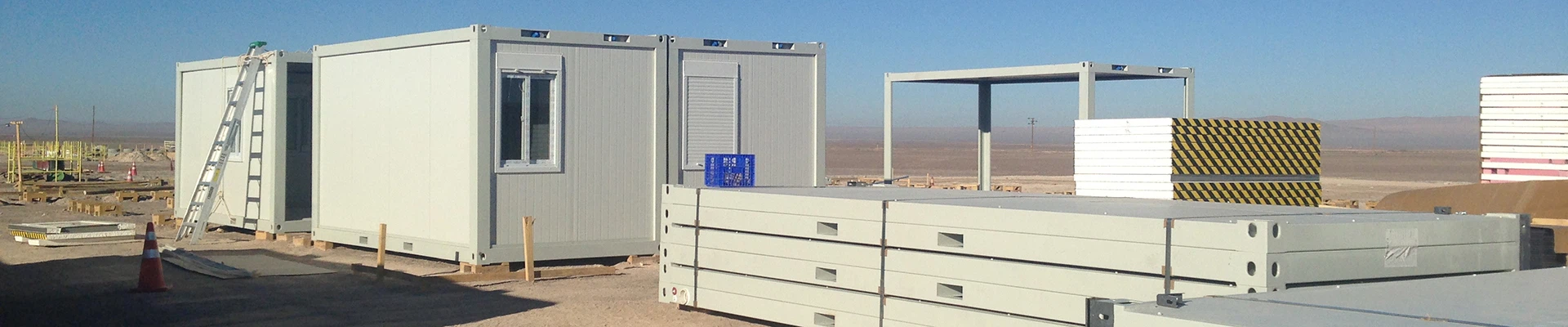
CBC integrate robust engineering, climate-specific design, and full-service operation (including cleaning, maintenance, and utilities management) is capturing the highest value in this growing market segment, we have already many successful project cases in Philippines, Indonesia, Chile and so on.
You Might Also Like



Send Inquiry
