

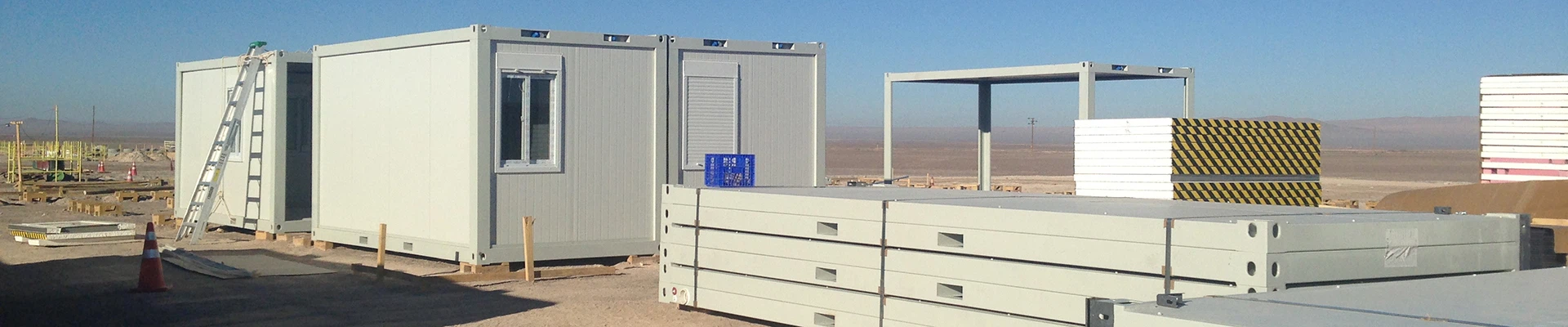


CBC Flatpack Container Temporary Office For Chile PTC Company
This project is a two-story temporary construction office built for Chile PTC Company’s construction site, using CBC standard Flatpack container houses. The standard dimensions of the CBC Flatpack container house are W2438mm × L6000mm × H2591mm. Each container is composed of an integral PU foam roof (with prefabricated circuits in the factory), a fully prefabricated floor (steel structure with waterway configuration, cement fiber floor and 2mm PVC floor), 14 EPS tongue-and-groove sandwich wall panels (75mm thick, with prefabricated doors and windows), and 4 CBC custom-made columns
Product Introduction
Design, Material List and Market Adaptability of CBC Flatpack Container Temporary Office for Chile PTC Company
1. Project Overview
This project is a two-story temporary construction office built for Chile PTC Company's construction site, using CBC standard Flatpack container houses. The standard dimensions of the CBC Flatpack container house are W2438mm × L6000mm × H2591mm. Each container is composed of an integral PU foam roof (with prefabricated circuits in the factory), a fully prefabricated floor (steel structure with waterway configuration, cement fiber floor and 2mm PVC floor), 14pcs of EPS tongue-and-groove sandwich wall panels (75mm thick, with prefabricated doors and windows), and 4 CBC custom-made columns. The entire building consists of 16 standard containers in total, including 11 containers on the first floor and 5 containers on the second floor, with a reasonable layout to meet the functional needs of the construction site office, dining, sanitation and rest.
2. Detailed Architectural Design
2.1 Overall Layout
The temporary office is a two-story building with a total of 16 CBC standard Flatpack containers. The first floor is composed of 11 containers arranged from west to east, and the second floor is composed of 5 containers, which are placed directly above the 3rd to 7th containers on the first floor. The roof of the remaining containers on the first floor is transformed into an accessible balcony, enclosed by CBC custom railings. A CBC steel staircase is installed on the north side of the first floor to connect the first and second floors for vertical traffic.

2.2 First Floor Design (11 Containers)
Containers 1-3 (Westmost): Connected as an integrated large canteen. The three containers are closely connected through CBC custom connecting parts, and the internal partitions are removed to form a large space. The prefabricated waterways of the container floor are connected to meet the water demand of the canteen (such as drinking water and cleaning water). The prefabricated circuits in the PU foam roof are extended and connected to install lighting and electrical equipment required for the canteen.
Containers 4-5: Used as toilets. Container 4 is designed as a men's toilet, and Container 5 is designed as a women's toilet. The prefabricated waterway system of the container floor is used to install squatting pans, hand wash basins and other sanitary facilities, and the drainage system is connected to the on-site temporary drainage pipeline. The prefabricated doors and windows on the wall panels are retained to ensure ventilation and lighting in the toilet.
Containers 6-7: Used as changing rooms and public bathrooms. Container 6 is the changing room, with simple lockers installed (fixed on the container steel structure); Container 7 is the public bathroom, which uses the prefabricated waterway of the container to install showers and sinks, and does a good job of waterproof treatment on the 2mm PVC floor. The wall panels are equipped with ventilation windows to prevent moisture accumulation.
Containers 8-10: Connected as a large-space office, shifted 1.5 meters southward as a whole relative to Containers 1-7 and 11. The three containers are connected into a whole, with internal partitions removed to form an open office area for on-site staff to work. The prefabricated circuits and lighting in the roof are used, and additional sockets are installed according to needs. The prefabricated doors and windows on the wall panels are adjusted appropriately to ensure good lighting and ventilation.
Container 11: Shifted 1.5 meters southward relative to Containers 8-10 (3 meters southward relative to Containers 1-7), used as an independent manager's office. The container retains its original independent structure, with a desk, chair and file cabinet placed inside. The prefabricated door and window on the wall panel are used as the entrance and exit and lighting window, and the internal circuit is connected to install air conditioning, lighting and other equipment.
2.3 Second Floor Design (5 Containers)
The second floor is composed of 5 containers, which are respectively placed directly above the 3rd to 7th containers on the first floor and connected into a large-space office. The 5 containers are closely connected through CBC custom connecting parts, and the internal partitions are removed to form an open office area for the management team. The prefabricated PU foam roof (with circuits) and floor of each container are retained and connected. The wall panels on the east and west sides are equipped with additional windows to increase lighting. The south and north sides of the second floor are equipped with guardrails (consistent with the balcony guardrails on the first floor) to ensure safety.

2.4 Auxiliary Facilities Design
CBC Steel Staircase: Installed on the north side of the first floor, between Containers 8 and 9, connecting the first floor and the second floor. The staircase is made of CBC customized steel structure, with a width of 1.2 meters, anti-slip steps, and handrails on both sides (consistent with the balcony guardrail style). The staircase is fixed on the steel structure of the container to ensure stability and meet the seismic requirements of Chile.
Accessible Balcony: The roofs of Containers 1-2, 8-11 on the first floor are transformed into accessible balconies (the roof of Containers 3-7 is covered by the second floor containers). The PU foam roof of the container is used as the balcony floor, and CBC custom railings (height 1.1 meters) are installed around the balcony to ensure safety. The railings are fixed on the container columns to ensure stability.
Connecting Parts: All containers (including the connection between the first and second floors, and the connection between adjacent containers on the same floor) are connected using CBC custom high-strength connecting bolts and sealing strips to ensure the overall stability of the building and prevent water leakage and air leakage.
Water and Electricity Extension: On the basis of the prefabricated water and electricity system of the container, extend the water pipes and circuits to meet the functional needs of each area (such as the canteen, bathroom, and office air conditioning). The water pipes and circuits adopt corrosion-resistant materials to adapt to the local climate of Chile.
3. Detailed Material List and Dosage
The material list is divided into three parts: standard container components, custom connecting and auxiliary materials, and additional functional materials, ensuring accuracy and detail for construction reference. All materials meet the relevant standards of Chile and the quality requirements of CBC Company.
3.1 Standard Container Components (16 Containers in Total)
|
Material Name |
Specification/Model |
Quantity |
Dosage (kg) |
Remarks |
|
Integral PU foam roof (with prefabricated circuit) |
W2438×L6000mm, with prefabricated wires and lamps |
16 pieces |
2880 |
CBC standard, each 180kg; circuit prefabricated in factory |
|
Prefabricated floor |
W2438×L6000mm, steel structure + waterway + cement fiber floor + 2mm PVC floor |
16 pieces |
5760 |
CBC standard, each 360kg; waterway prefabricated for daily use |
|
EPS tongue-and-groove sandwich wall panel |
75mm thick, with prefabricated doors and windows |
224 pieces |
7840 |
14 pieces per container, each 35kg; doors and windows prefabricated |
|
CBC custom column |
H2591mm, steel structure, customized by CBC |
64 pieces |
3840 |
4 pieces per container, each 60kg; used to support roof and connect floors |
|
Prefabricated door and window accessories |
Matching the wall panel, aluminum alloy frame |
32 sets (16 doors, 16 windows) |
512 |
1 door and 1 window per container, each set 16kg |
|
Prefabricated circuit accessories |
Switches, sockets, wires, lamps |
16 sets |
256 |
Matching the PU foam roof circuit, each set 16kg |
|
Prefabricated waterway accessories |
Water pipes, valves, connectors |
16 sets |
384 |
Matching the prefabricated floor, each set 24kg |
|
Subtotal of Standard Components |
- |
- |
21472 |
- |
3.2 Custom Connecting and Auxiliary Materials
|
Material Name |
Specification/Model |
Quantity |
Dosage (kg) |
Remarks |
|
CBC custom high-strength connecting bolt |
M20×80, 10.9 grade, anti-corrosion |
800 pieces |
720 |
Used to connect adjacent containers and floors; each 0.9kg |
|
Sealing strip |
Waterproof and dustproof, EPDM material |
1000 meters |
500 |
Used for container connection gaps; 0.5kg per meter |
|
CBC custom steel staircase |
Width 1.2m, steel structure, anti-slip steps |
1 set |
800 |
Connect first and second floors, with handrails; anti-seismic design |
|
CBC custom balcony railing |
Height 1.1m, steel structure, anti-corrosion |
80 meters |
960 |
Used for first-floor accessible balcony and second-floor perimeter; 12kg per meter |
|
Steel connecting beam |
H200×100×5×8, steel structure |
30 pieces |
720 |
Used to strengthen the connection between containers; each 24kg |
|
Anti-corrosion paint |
Anti-rust, anti-ultraviolet, suitable for Chile climate |
50 barrels |
500 |
10kg per barrel; used for steel components such as stairs and railings |
|
Subtotal of Custom Auxiliary Materials |
- |
- |
4200 |
- |
3.3 Additional Functional Materials
|
Material Name |
Specification/Model |
Quantity |
Dosage (kg) |
Remarks |
|
Sanitary facilities |
Squatting pans, hand wash basins, showers |
1 set (6 squatting pans, 4 basins, 4 showers) |
360 |
Used for toilets (Containers 4-5) and bathrooms (Container 7) |
|
Water pipe extension |
PVC material, Φ50/Φ32 |
200 meters |
200 |
Extend prefabricated waterway to connect sanitary facilities and canteen |
|
Circuit extension |
Copper wire, 2.5mm²/4mm² |
300 meters |
150 |
Extend prefabricated circuit to install additional sockets and air conditioners |
|
Additional sockets and switches |
Waterproof, industrial grade |
50 sets |
50 |
Used for offices, canteen and other areas; each 1kg |
|
Waterproof coating |
Polyurethane waterproof coating |
20 barrels |
200 |
10kg per barrel; used for bathroom (Container 7) and balcony floor |
|
Locker |
Steel structure, single door |
20 pieces |
600 |
Used for changing room (Container 6); each 30kg |
|
Additional window |
Aluminum alloy, 1.2m×1.0m, with glass |
10 pieces |
320 |
Installed on second-floor containers to increase lighting |
|
Subtotal of Additional Functional Materials |
- |
- |
1880 |
- |
3.4 Total Material Dosage
Total dosage of standard container components: 21472 kg (21.47 tons)
Total dosage of custom auxiliary materials: 4200 kg (4.20 tons)
Total dosage of additional functional materials: 1880 kg (1.88 tons)
Total dosage of the whole project: 27552 kg (27.55 tons)

4. Advantages of CBC Flatpack Container Temporary Office
4.1 High Prefabrication Degree and Fast Construction
All components of the CBC Flatpack container house (roof, floor, wall panels, columns) are prefabricated in the factory, including circuits, waterways, doors and windows. On the construction site, only assembly and connection are required, which greatly shortens the construction period. For this two-story temporary office project, the on-site assembly can be completed within 15 days, which is much faster than the traditional brick-concrete structure, effectively meeting the urgent needs of the construction site for temporary office space.
4.2 Strong Mobility and Reusability
The container house adopts a modular design, and each container is an independent unit, which can be disassembled, moved and reused flexibly. After the PTC company's construction project is completed, the temporary office can be disassembled and transported to other construction sites for reassembly, reducing the waste of materials and construction costs. At the same time, the damage to the construction site is small during disassembly and assembly, which is in line with the concept of green construction.
4.3 Good Structural Stability and Seismic Performance
The container house is composed of high-strength steel structure columns and connecting parts, with strong overall stability. Combined with the anti-seismic design of the steel staircase and connecting beams, it can meet the seismic intensity requirements of Chile (up to 9 degrees). The integral PU foam roof and EPS sandwich wall panels have good wind resistance, which can adapt to the strong wind weather in coastal areas of Chile.
4.4 Complete Functions and Comfortable Use
The prefabricated floor of the container is equipped with a complete waterway system and a two-layer floor (cement fiber floor + PVC floor), which is waterproof and wear-resistant; the integral PU foam roof has good thermal insulation performance and prefabricated circuits, which can meet the needs of lighting and electrical equipment; the EPS sandwich wall panels have good thermal insulation and sound insulation effects, creating a comfortable working and living environment for the on-site staff. The reasonable layout of the project (canteen, toilet, office, changing room) also meets the multi-functional needs of the construction site.
4.5 Economical and Environmentally Friendly
The container house has low construction cost, short construction period, and can be reused many times, which greatly reduces the comprehensive cost of temporary buildings. At the same time, the factory prefabrication reduces the on-site construction waste, and the materials are recyclable, which is in line with the global green and low-carbon development trend. In addition, the anti-corrosion treatment of steel components extends the service life of the building, further reducing the cost of later maintenance.

5. Scope of Application
The CBC Flatpack container temporary office, with its advantages of fast construction, strong mobility, complete functions and good stability, has a wide scope of application, mainly including the following fields:
5.1 Construction Site Temporary Facilities
It is mainly used as temporary offices, dormitories, canteens, toilets, changing rooms and other facilities on construction sites (such as building construction, road construction, bridge construction, etc.), which can meet the living and working needs of on-site staff. This project is a typical application in the construction site of Chile PTC Company.
5.2 Emergency Rescue and Disaster Relief
In the event of natural disasters (earthquakes, floods, typhoons, etc.), the container house can be quickly transported to the disaster area and assembled into temporary resettlement houses, medical points, command centers, etc., because of its fast assembly speed and strong mobility, which provides timely support for emergency rescue and disaster relief.
5.3 Temporary Commercial and Public Facilities
It can be used as temporary commercial facilities (temporary stores, exhibition halls, booths) and public facilities (temporary hospitals, schools, community service centers) in areas with temporary needs, such as urban renovation, large-scale activities, and remote areas with underdeveloped infrastructure.
5.4 Industrial and Mining Enterprises Temporary Buildings
In industrial and mining enterprises (mines, factories, etc.), it can be used as temporary offices, shift rooms, warehouses, and maintenance rooms for on-site staff, adapting to the harsh working environment of industrial and mining areas with its strong structural stability and anti-corrosion performance.
5.5 Remote Areas and Field Operations
For field operations (geological exploration, oil exploration, power construction, etc.) and remote areas with inconvenient transportation and underdeveloped infrastructure, the container house is easy to transport and assemble, and can provide a stable and comfortable temporary living and working space for the staff.

6. Adaptability to CBC's Other Main Markets
CBC's main markets include Chile, the Philippines, Papua New Guinea, South Africa and other countries. The CBC Flatpack container house, with its modular design and adjustable performance, can be adapted to the different natural conditions, market needs and relevant standards of each country through simple adjustments, showing good market adaptability.
6.1 Philippines Market
The Philippines is located in the tropical monsoon climate zone, with high temperature, heavy rainfall, frequent typhoons (basic wind speed up to 50 m/s) and frequent earthquakes (seismic intensity up to 7-8 degrees). The adaptability adjustment measures of the container house are as follows: 1) Wind resistance adjustment: Strengthen the connection between containers, increase the number of connecting bolts and connecting beams, and optimize the roof structure to improve the wind resistance; 2) Seismic adjustment: Add anti-seismic isolation pads at the bottom of the container columns to reduce the impact of earthquakes, and use more flexible connecting nodes to improve the ductility of the structure; 3) Anti-corrosion and moisture-proof adjustment: Adopt higher-grade anti-corrosion paint for steel components to adapt to the humid and salty marine climate, and add moisture-proof layers in the wall panels and floors to prevent moisture accumulation; 4) Drainage adjustment: Optimize the roof slope and add additional drainage pipes to ensure smooth drainage in heavy rain. The container house can be used as temporary facilities for construction sites, emergency resettlement houses and other fields in the Philippines, meeting the local market needs.
6.2 Papua New Guinea Market
Papua New Guinea is located in the tropical rainforest climate zone, with high temperature, high humidity, heavy rainfall, frequent earthquakes and complex geological conditions (many mountainous areas, poor foundation bearing capacity). The adaptability adjustment measures are as follows: 1) Foundation adjustment: For areas with low foundation bearing capacity, adopt strip foundations or pile foundations to improve the bearing capacity; 2) Ventilation and moisture-proof adjustment: Increase the number of windows and install ventilation fans to improve indoor ventilation, and use moisture-proof EPS core materials for wall panels to prevent moisture corrosion; 3) Transportation and construction adjustment: Split large components into small sections for transportation to adapt to the underdeveloped traffic in mountainous areas, and adopt simple and easy-to-construct connection methods to adapt to the local construction level; 4) Seismic and wind resistance adjustment: Refer to the local seismic design codes, optimize the structural system to improve seismic performance, and strengthen the roof and wall panels to resist strong winds and heavy rainfall. The container house is very suitable for temporary offices, dormitories and other facilities in the construction sites and mining areas of Papua New Guinea.
6.3 South Africa Market
South Africa has a subtropical climate, with large temperature difference between day and night, strong solar radiation, occasional strong winds and earthquakes (seismic intensity up to 6-7 degrees), and high humidity in some areas. The adaptability adjustment measures are as follows: 1) Thermal insulation adjustment: Add a layer of thermal insulation cotton between the roof and wall panels to improve thermal insulation performance, and use color steel plates with anti-ultraviolet coating to slow down aging caused by strong solar radiation; 2) Anti-corrosion adjustment: Adopt hot-dip galvanizing + anti-corrosion paint treatment for steel components to adapt to the local humidity and climate, and extend the service life; 3) Temperature difference adjustment: Set expansion joints in the structure to release the stress caused by thermal expansion and contraction, preventing structural deformation; 4) Wind and seismic adjustment: Appropriately increase the section size of columns and connecting beams to improve wind resistance and seismic performance. The container house can be used as temporary offices, commercial facilities and emergency resettlement houses in South Africa, meeting the local market's demand for temporary buildings with energy conservation, environmental protection and stability.
6.4 Summary of Market Adaptability
The CBC Flatpack container house has a modular and standardized design, and its core components (roof, floor, wall panels) can be adjusted according to the local climate (temperature, rainfall, wind speed), geological conditions (foundation bearing capacity, seismic intensity), market needs (functional requirements, construction level) and relevant codes of each country. It has good adaptability in CBC's main markets (Chile, the Philippines, Papua New Guinea, South Africa, etc.), can meet the diverse needs of different markets for temporary buildings, and has broad market prospects.

7. Conclusion
The two-story temporary office designed for Chile PTC Company using CBC standard Flatpack container houses fully meets the functional needs of the construction site, with reasonable layout, complete facilities, and detailed and accurate material list for construction reference. The CBC Flatpack container house has the advantages of fast construction, strong mobility, good stability, complete functions, economy and environmental protection, and has a wide scope of application, which can be widely used in construction sites, emergency rescue, industrial and mining enterprises and other fields. At the same time, through simple adaptive adjustments, the container house can meet the different needs of CBC's other main markets (the Philippines, Papua New Guinea, South Africa, etc.), showing strong market competitiveness and broad development prospects.
You Might Also Like


Send Inquiry
