

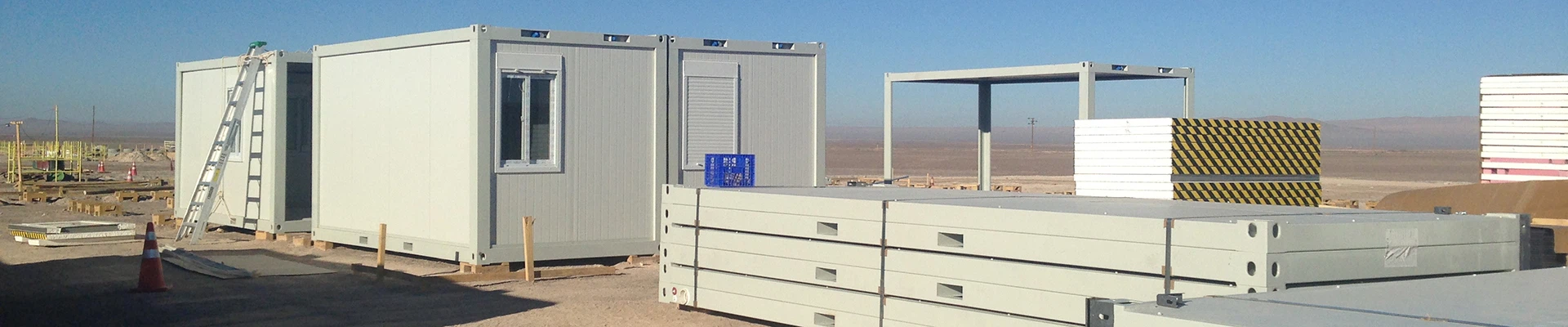


Flat Pack Container Accommodation Building
Size:6000*2438*2591mm
Steel Structure:Prefab steel structure
Wall Panel:0.326/0.376/0.426/0.476mm THC steel sheet
50/75/100mm THC EPS / rock wool / glass wool / PU sandwich panel
Product Introduction
The best Flat Pack Container Accommodation Building from China
Flat Pack Container Accommodation Building (FPCAB) has been increasingly used in post-disaster reconstruction work due to its quick and efficient construction, cost-effectiveness, and durability. These pre-manufactured containers are usually made from steel, aluminum, or other materials that are resistant to harsh weather conditions, fire, and corrosion, ensuring their suitability for temporary or permanent housing in disaster-prone areas. In this article, we will explore the benefits and challenges of using FPCAB in disaster recovery efforts and examine some successful cases that illustrate their potential.
First, let us consider the advantages of FPCAB. One of the most significant benefits is the speed of construction. Traditional building methods often take months to complete, whereas FPCAB can be assembled in a matter of days or weeks, depending on the scale of the project. This efficiency is critical in disaster situations when time is of the essence, and people need shelter quickly. Moreover, FPCAB can be easily transported and stacked, providing flexible solutions for different sites and populations. The pre-manufactured design also minimizes on-site work, reducing labor costs and minimizing the impact on the environment.
Another advantage of Flat Pack Container Accommodation Building is its affordability. Compared with traditional construction, FPCAB has lower materials and labor costs, making it more accessible to low-income communities that are often the hardest hit by disasters. Additionally, FPCAB can be customized to meet specific needs and preferences, such as adding insulation, windows, doors, or furniture, to improve living conditions. This versatility makes FPCAB suitable for a wide range of purposes beyond housing, such as clinics, schools, offices, and warehouses.
Flat Pack Container Accommodation Building is also durable and sustainable. As mentioned earlier, the materials used in FPCAB are resistant to natural disasters and weather extremes, making them sturdy and long-lasting. Furthermore, the containers can be recycled or repurposed after their initial use, reducing waste and minimizing the environmental impact. This sustainability aspect aligns with the United Nations Sustainable Development Goals, which call for responsible consumption and production patterns.
Despite its many advantages, FPCAB also presents some challenges that need to be addressed. One of the main concerns is the lack of privacy and space. Containers are relatively small and cramped, which can lead to overcrowding and social problems if not managed properly. To mitigate this issue, designers should aim to optimize the available resources and create spaces that are functional and comfortable. Another challenge is the stigma attached to living in containers, which can discourage people from accepting them as legitimate housing options. To counter this, communication and education campaigns should emphasize the benefits of FPCAB and the temporary nature of their use.
Now, let us examine some successful cases of FPCAB in disaster recovery efforts. In the aftermath of the 2010 earthquake in Haiti, a team of architects and engineers developed a prototype for a simple, low-cost container housing solution that could be easily assembled by unskilled workers. Dubbed the "Exo-Container," the design features an open-air core that provides natural ventilation and a communal space, with private rooms and bathrooms arranged around the perimeter. This configuration maximizes privacy and social interaction while minimizing the building's footprint. The Exo-Container has since been used in other disaster zones, such as the Philippines, where it was adapted to local needs.
Another example is the Container City project in London, UK. Originally built as an arts center in 2001, the project has evolved into a mixed-use development that includes apartments, offices, and shops. The containers were stacked in a dynamic, colorful configuration that reflects their industrial heritage and creates a vibrant urban landscape. The success of Container City demonstrates the potential of FPCAB as a sustainable, creative, and adaptable building solution, not just for disaster recovery but also for urban regeneration and affordable housing.
In conclusion, Flat Pack Container Accommodation Building has emerged as a promising alternative to traditional construction in post-disaster reconstruction work. Its speed, affordability, durability, and sustainability make it a practical and effective solution for housing and other uses. While there are some challenges to overcome, FPCAB has already proven its worth in various contexts, from Haiti to London, and has the potential to transform the way we approach housing and construction in the future. As we face more frequent and intense disasters due to climate change and other factors, FPCAB could be a lifeline for those in need of shelter and hope.

Advantages
|
No. |
Item |
CBC Flat Pack Container Accommodation Building |
Evolution |
Other Brand Prefabricated House |
Evolution |
|
1 |
Steel Structure |
Galvanized steel beams in 3mm thickness, high structure strength and durability |
★★★★★ |
only painted steel beams in 2~2.5mm thick, low structure strength and not durabe |
★★★ |
|
2 |
Electrical System |
All embedded in the roof and wall panels, save onsite labor cost |
★★★★★ |
need to be installed onsite, cause extra onsite labor cost |
★★★ |
|
3 |
Plumbing Pipes |
Pre-installed in the base frame, save onsite labor cost |
★★★★★ |
need to drill holes and install on site, cause extra onsite labor cost |
★ |
|
4 |
Window & Door |
pre-installed in the wall panels, save onsite labor cost |
★★★★★ |
need to be installed onsite, cause extra onsite labor cost |
★★★ |
|
5 |
Steel Pretreatment |
CBC advanced sand blasting equipment line, improve painting adhesion and durability |
★★★★★ |
outsourced processing or no pretreatment, low painting adhesion and durability |
★★★ |
|
6 |
Painting |
CBC painting line to ensure good painting quality |
★★★★★ |
outsourced painting, can’t ensure the painting quality |
★★★ |
|
7 |
advanced paint technology, water-based painting available, environment friendly |
★★★★★ |
only oil-based painting, cause damage to the environment |
★★★ |
|
|
8 |
Degree of Prefabrication |
70-90% as per customer requirement, save onsite labor cost |
★★★★★ |
around 30% or only loosen parts available, cause extra site labor cost |
★★ |
|
9 |
Marking |
two-dimensional code component tracking system can effectively manage each component |
★★★★★ |
No label or very simple label, can’t track every component |
★★ |
|
10 |
Fast Installation |
4 workers could install 2 units in one day. |
★★★★★ |
Need many workers on site to install. |
★★ |
|
11 |
Packing & Delivery |
special steel packing pallets to protect materials within the shipping container during the long-distance shipping |
★★★★★ |
no packing frame, easy to cause damage to the material |
★★★ |
|
12 |
SOC packing method for short-distance transportation, no need to load into shipping container, save the shipping cost |
★★★★★ |
only can load into shipping container |
★★★ |

You Might Also Like



Send Inquiry
