




STRUCTURAL ANALYSIS AND OPTIMIZATION OF STEEL HANGAR – NEW CALEDONIA
Structural capacity: Main frame adequately sized; column web is Class 4 – increase to 8 mm or perform effective section analysis. Total steel weight: Approximately 69 tonnes (52 t hangar + 11 t mezzanine + 10% allowances). Transferability: Directly applicable only in New Caledonia. Indonesia requires seismic ductility; Philippines/Tonga need wind upgrades; Chile requires complete seismic redesign. Optimization potential: 14–19% weight reduction achievable through wider frame spacing, mezzanine downsizing, and haunch shortening.
Product Introduction
STRUCTURAL ANALYSIS AND OPTIMIZATION OF STEEL HANGAR – NEW CALEDONIA
Project location: New Caledonia (baseline), with applicability review for Philippines, Indonesia, Tonga, and Chile.

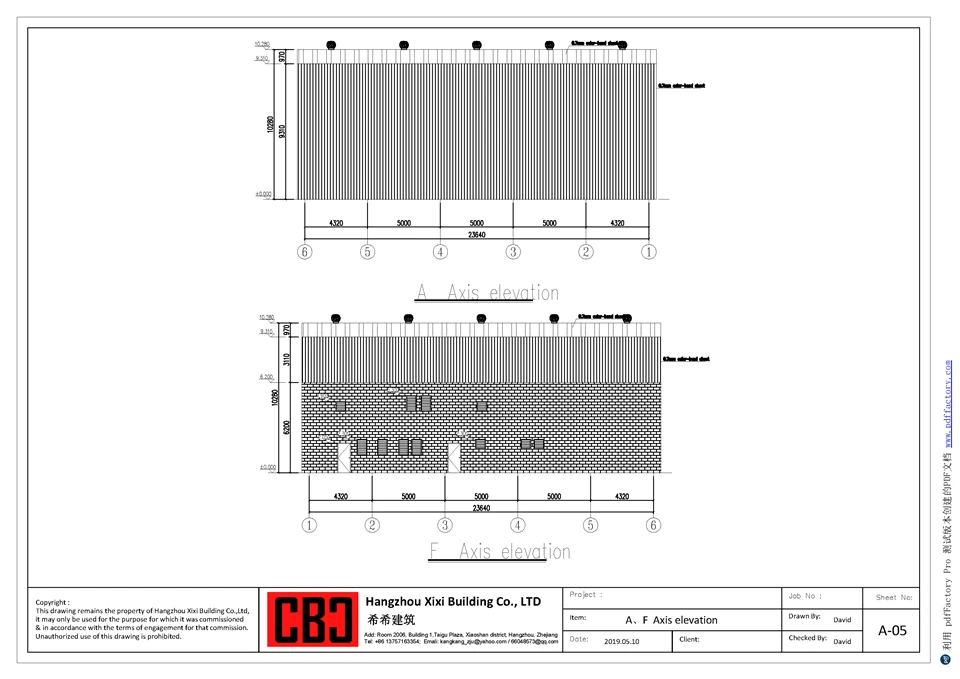
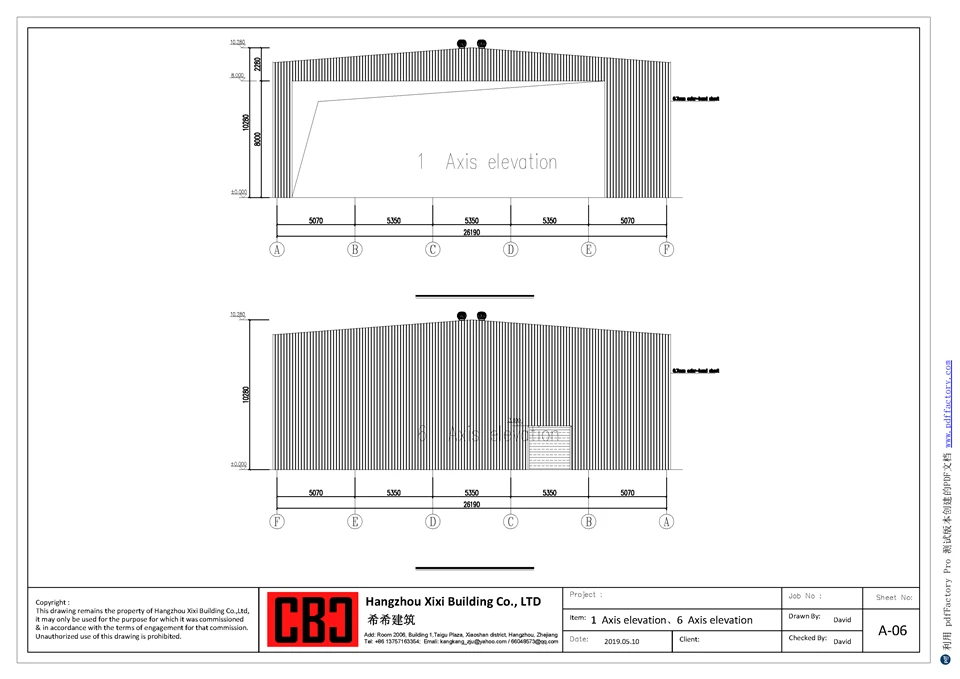
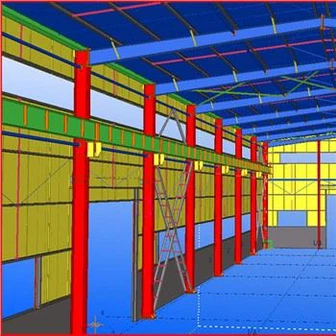
1. Structural Configuration Summary
|
Parameter |
Value |
|
Building length |
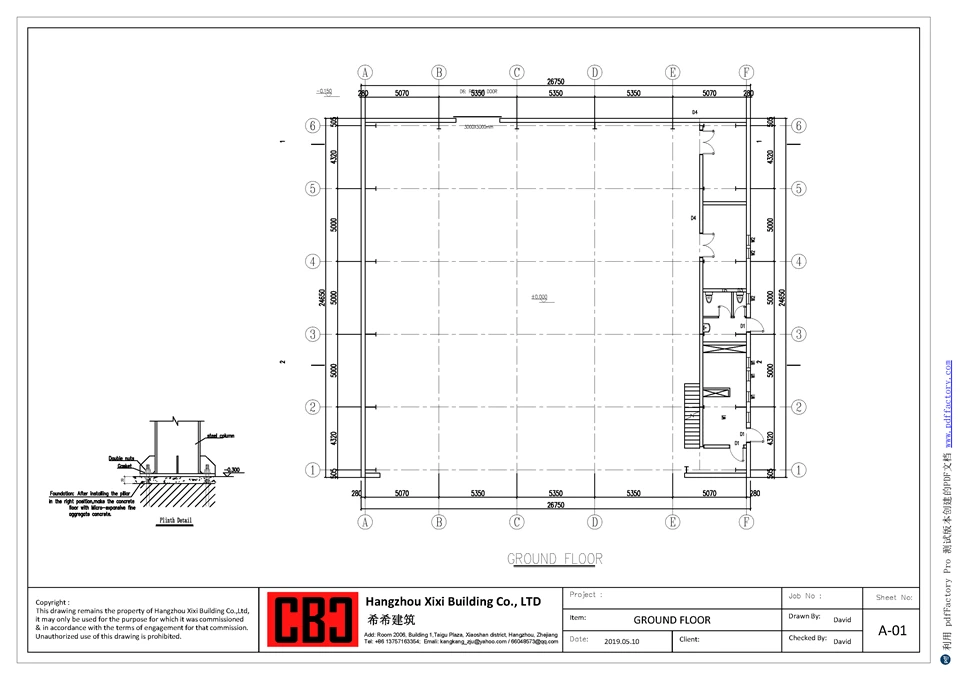
25.0 m |
|
Single clear span |
26.75 m |
|
Eave height |
9.0 m |
|
Side columns |
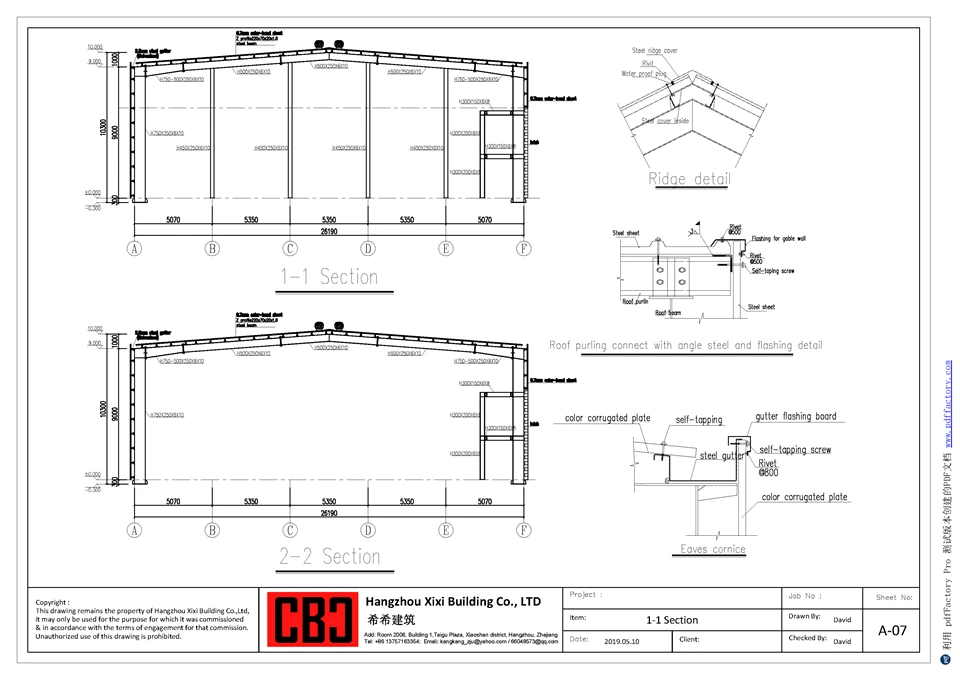
H750×250×6×10 (welded built-up) |
|
Gable (wind) columns |
H450×250×6×10 |
|
Roof beam (haunched segment) |
H750–500×250×6×10 (tapered) |
|
Roof beam (prismatic segment) |
H500×250×6×10 |
|
Mezzanine (one side) |
25 m × 3 m, three-storey |
|
Mezzanine columns |
H300×200×6×8 |
|
Mezzanine beams |
H300×150×6×8 |
2. Structural Load Analysis
2.1 Load Evaluation
Dead Load (DL): Main frame self-weight 0.40–0.55 kN/m²; mezzanine floor 4.0 kN/m² (125 mm RC composite slab).
Live Load (LL): Hangar 5.0 kN/m²; Mezzanine 3.0 kN/m²; Roof 0.4 kN/m² (EN 1991-1-1).
Wind Load (WL): Basic wind velocity vb,0 = 36 m/s (EN 1991-1-4), peak velocity pressure qp(z) ≈ 1.25–1.45 kN/m².
Seismic Load (EQ): Zone 4, agR = 1.6 m/s² (French seismic zoning). The three-storey mezzanine introduces torsional eccentricity.
2.2 Critical Load Combinations (EN 1990 – ULS)
|
Combination |
Formula |
Governing Component |
|
LC1 |
1.35 DL + 1.5 LL |
Column axial, mezzanine beams |
|
LC2 |
1.35 DL + 1.5 WL (pressure) |
Column bending, foundation uplift |
|
LC3 |
1.0 DL + 1.5 WL (suction) |
Roof beam reversal, purlin anchorage |
|
LC4 |
1.0 DL + 1.0 LL ± 1.0 EQ |
Mezzanine lateral drift, ductility |
Wind load (LC2/LC3) typically governs the main frame for this 26.75 m span.
2.3 Member Force Assessment
Side Column H750×250×6×10 (9.0 m high): Web slenderness hw/tw = 730/6 = 121.7 → Class 4 (slender). Effective section must be used, reducing flexural capacity by ~15–20%.
Wind Column H450×250×6×10: Lateral deflection ≈ h/150–h/200; acceptable for gable end but marginal.
Roof Beam (haunched + prismatic): H500×250×6×10 elastic moment capacity ~648 kN·m (S355), ample for mid-span moment of ~197 kN·m.
Mezzanine: Columns and beams are significantly over-designed for gravity loads (column demand ~79 kN vs. capacity ~15,800 kN). Lateral stability in transverse direction requires dedicated bracing due to single-sided attachment.
2.4 Deflection & Drift Summary
|
Component |
Estimated Drift/Deflection |
Limit |
Status |
|
Side column top (wind) |
h/200–h/164 |
h/150 |
Acceptable |
|
Roof beam mid-span (DL+LL) |
L/760–L/595 |
L/250 |
Ample |
|
Mezzanine inter-storey (EQ) |
h/375–h/250 |
h/300 |
Borderline |
|
Gable column top |
h/164–h/138 |
h/200 |
Marginal |

3. Steel Tonnage Calculation
3.1 Unit Weights of Built-Up Sections
|
Section |
tw (mm) |
h (mm) |
tf (mm) |
b (mm) |
Area (mm²) |
Weight (kg/m) |
|
H750×250×6×10 |
6 |
750 |
10 |
250 |
9,380 |
73.6 |
|
H450×250×6×10 |
6 |
450 |
10 |
250 |
7,580 |
59.5 |
|
H750–500 average |
6 |
- |
10 |
250 |
8,480 |
66.6 |
|
H300×200×6×8 |
6 |
300 |
8 |
200 |
4,904 |
38.5 |
|
H300×150×6×8 |
6 |
300 |
8 |
150 |
4,104 |
32.2 |
3.2 Quantities and Total Tonnage
Main Hangar Frame (Single Portal)
|
Member |
Section |
Length (m) |
Qty |
Total (m) |
kg/m |
Weight (kg) |
|
Side column |
H750×250×6×10 |
9.0 |
2 |
18.0 |
73.6 |
1,325 |
|
Wind column |
H450×250×6×10 |
9.0 |
4 |
36.0 |
59.5 |
2,142 |
|
Roof beam (haunched) |
H750–500 avg |
13.4 |
2 |
26.8 |
66.6 |
1,785 |
|
Roof beam (prismatic) |
H500×250×6×10 |
13.4 |
2 |
26.8 |
59.5 |
1,595 |
|
Subtotal per portal frame |
6,847 |
|||||
6 frames at 5.0 m spacing: 6 × 6,847 = 41,082 kg
|
Other Components |
Weight (kg) |
|
Roof purlins (C/Z, 1.2 m spacing) |
4,675 |
|
Wall girts (side + gable) |
3,881 |
|
Bracing (roof + wall) |
2,500 |
|
Subtotal Main Hangar |
52,138 |
Three-Storey Mezzanine (25 m × 3 m)
|
Member |
Section |
Length (m) |
Qty |
Total (m) |
kg/m |
Weight (kg) |
|
Columns |
H300×200×6×8 |
9.0 |
6 |
54.0 |
38.5 |
2,079 |
|
Longitudinal beams |
H300×150×6×8 |
5.0 |
18 |
90.0 |
32.2 |
2,898 |
|
Transverse beams |
H300×150×6×8 |
3.0 |
15 |
45.0 |
32.2 |
1,449 |
|
Floor decking (steel) |
- |
- |
225 m² |
- |
12 kg/m² |
2,700 |
|
Stairs + bracing (allowance) |
- |
- |
- |
- |
- |
1,500 |
|
Subtotal Mezzanine |
10,626 |
|||||
3.3 Total Steel Tonnage
|
Category |
Weight (kg) |
Tonnes |
|
Main hangar structure |
52,138 |
52.1 |
|
Three-storey mezzanine |
10,626 |
10.6 |
|
+10% connections, base plates, misc. |
6,276 |
6.3 |
|
Grand Total |
69,040 |
~69.0 |
Estimated material cost (fabricated steel): please inquiry CBC for cost estimation.

4. Applicability Assessment by Country
4.1 New Caledonia (Baseline) – Good suitability
Wind 36 m/s, seismic zone 4 – design appropriate. Corrosion protection to C4–C5 marine environment essential.
4.2 Philippines – Marginal – requires redesign
Typhoon wind speeds 200–250 kph (3-s gust → ~40–50 m/s 10-min mean) exceed New Caledonia. High seismicity (PGA up to 1.0g). Columns likely need upsizing; mezzanine eccentricity critical. Recommend member upsizing + seismic bracing.
4.3 Indonesia – Acceptable with seismic retrofit
Wind moderate but seismicity very high (base shear 0.15g–0.35g). Mezzanine must be structurally separated or provided with ductile detailing. Add roof-level bracing and RBS connections.
4.4 Tonga – Conditionally suitable after wind upgrade
Cyclone region (Region C, AS/NZS 1170.2), wind 60–70 m/s gust. Upsize portal members (columns H800–900, rafters deeper). Cyclone-rated connections and cladding required.
4.5 Chile – Not suitable without full seismic redesign
Extreme seismicity (NCh 433, base shear up to 0.40g). Highly irregular mass distribution (single-sided mezzanine) would fail torsional checks. Mandatory: separate mezzanine, add braced frames, use toughness-rated steel (Charpy ≥27J at 0°C).
4.6 Comparative Summary
|
Country |
Wind Critical? |
Seismic Critical? |
Current Design Adequate? |
Primary Modification |
|
New Caledonia |
Yes (moderate) |
Moderate |
Yes |
Corrosion protection |
|
Philippines |
Yes (typhoon) |
Yes (high) |
No |
Upsize for wind + seismic bracing |
|
Indonesia |
Moderate |
Yes (very high) |
Partially |
Mezzanine separation + ductile detailing |
|
Tonga |
Yes (cyclone) |
Moderate |
No |
Upsize for cyclone wind |
|
Chile |
Low-Moderate |
Yes (extreme) |
No |
Full seismic redesign |

5. Structural Optimization Opportunities
5.1 Column Web Classification
H750 web slenderness 121.7 → Class 4. Increase web to 8 mm (H750×250×8×10) to achieve Class 3 and full effectiveness.
5.2 Mezzanine Member Downsizing
|
Option |
Column |
Beam |
Saving in mezzanine |
|
Conservative |
H250×150×6×8 |
H250×125×6×8 |
~25% |
|
Optimized |
H200×150×5×7 |
H200×100×5×7 |
~45% |
Potential saving: 3–5 tonnes.
5.3 Portal Frame Spacing
Increase spacing to 6.25 m (5 frames over 25 m) → eliminates one frame, saves ~5.5–6.0 tonnes. (Suitable for New Caledonia; retain closer spacing for cyclone regions.)
5.4 Haunch Geometry
Shorten haunch to 8–10 m based on moment envelope; could save 600–800 kg per frame.
5.5 Corrosion Protection Optimization
Duplex system (HDG + polysiloxane) extends maintenance intervals to 30–40 years in C5 environments.
5.6 Optimization Summary
|
Strategy |
Steel Saving (tonnes) |
% of Total |
|
Mezzanine downsizing |
3–5 |
4–7% |
|
Frame spacing increase (5 frames) |
5.5–6.0 |
8–9% |
|
Haunch length reduction |
3.5–4.8 |
5–7% |
|
Web thickness optimisation |
–2.5 (increase) |
–4% |
|
Net Potential Saving |
9.5–13.3 |
14–19% |
Optimized tonnage: 55–60 tonnes.

6. Conclusion
Structural capacity: Main frame adequately sized; column web is Class 4 – increase to 8 mm or perform effective section analysis.
Total steel weight: Approximately 69 tonnes (52 t hangar + 11 t mezzanine + 10% allowances).
Transferability: Directly applicable only in New Caledonia. Indonesia requires seismic ductility; Philippines/Tonga need wind upgrades; Chile requires complete seismic redesign.
Optimization potential: 14–19% weight reduction achievable through wider frame spacing, mezzanine downsizing, and haunch shortening.

You Might Also Like



Send Inquiry
