

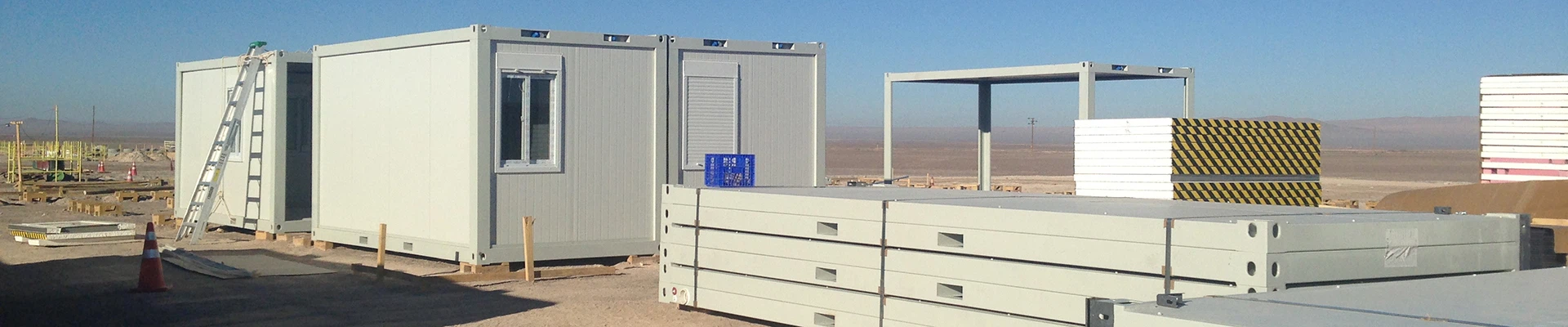
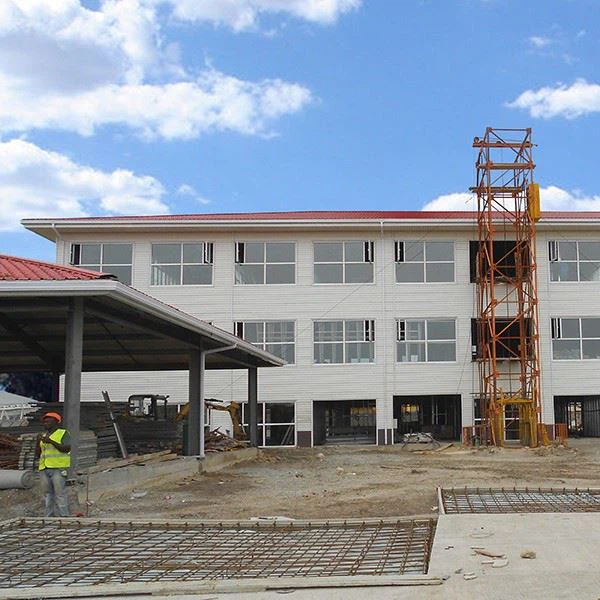


Office Building in Port Moresby, Papua New Guinea Using CBC Steel Building System
The CBC steel-framed office building designed for Port Moresby is a robust, modular solution that can be effectively adapted to diverse global markets. While the core structural logic remains consistent, local environmental hazards (wind, seismic, corrosion), material availability, and regulatory frameworks dictate necessary modifications. With targeted engineering adjustments, this design offers a scalable, durable, and rapidly deployable office solution across the Philippines, Latin America, Pacific Islands, Southern Africa, and Southeast Asia
Product Introduction
Design and Market Adaptability Analysis of an Office Building in Port Moresby, Papua New Guinea Using CBC Steel Building System
Q1: What is the overall structural layout of the proposed 80-meter-long office building in Port Moresby using the CBC steel building system?
A1:
The building is a single-story steel-framed office structure with the following key parameters:
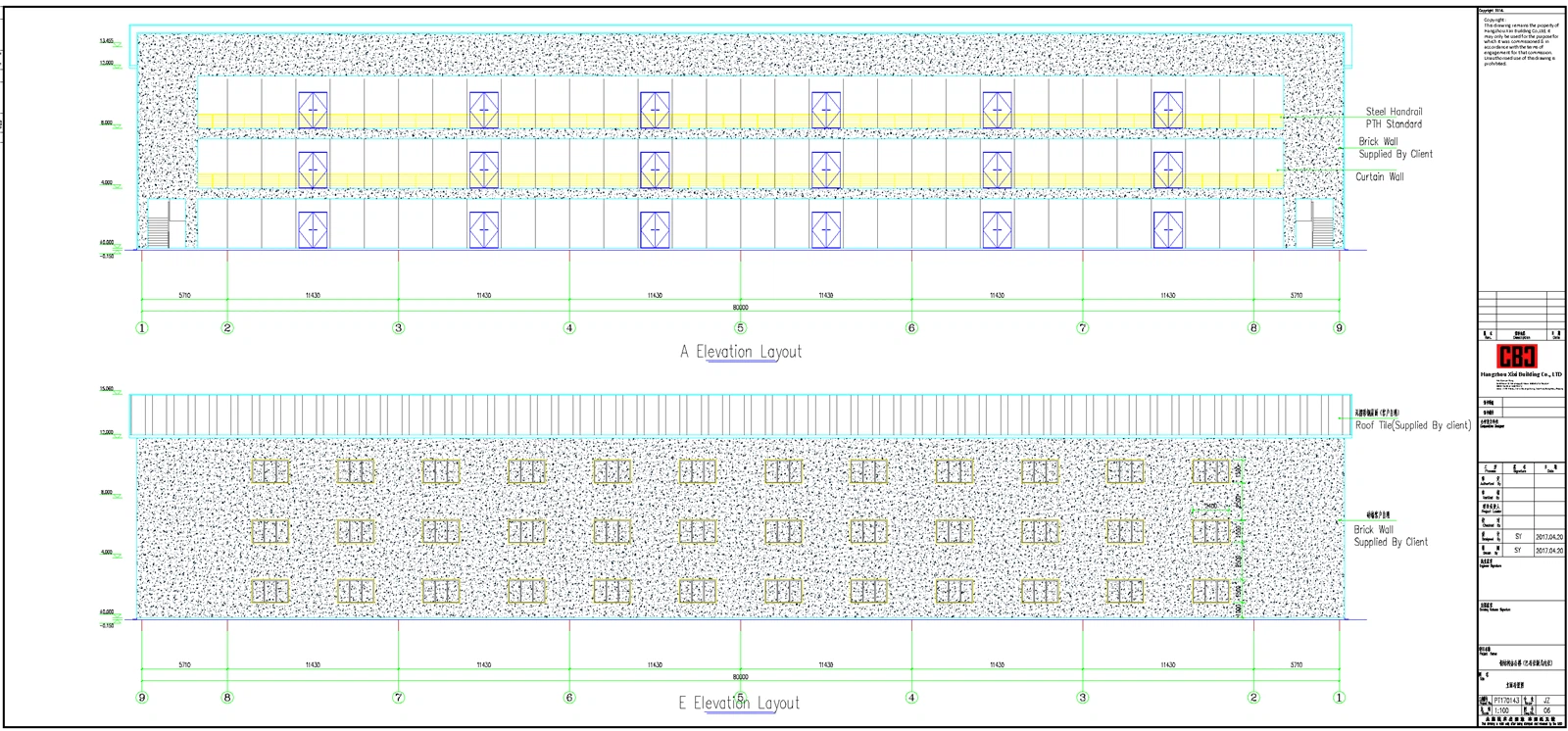
Plan dimensions: 80.0 m (length) × 25.0 m (width), with 0.5 m roof overhangs on all sides → total roof footprint = 81.0 m × 26.0 m.
Bay division along length: 8 bays configured as:
5.71 m + 11.43 m × 6 + 5.71 m = 80.0 m
The two end bays (5.71 m each) house stairwells and toilets.
The six central bays (11.43 m each) are dedicated to enclosed office modules.
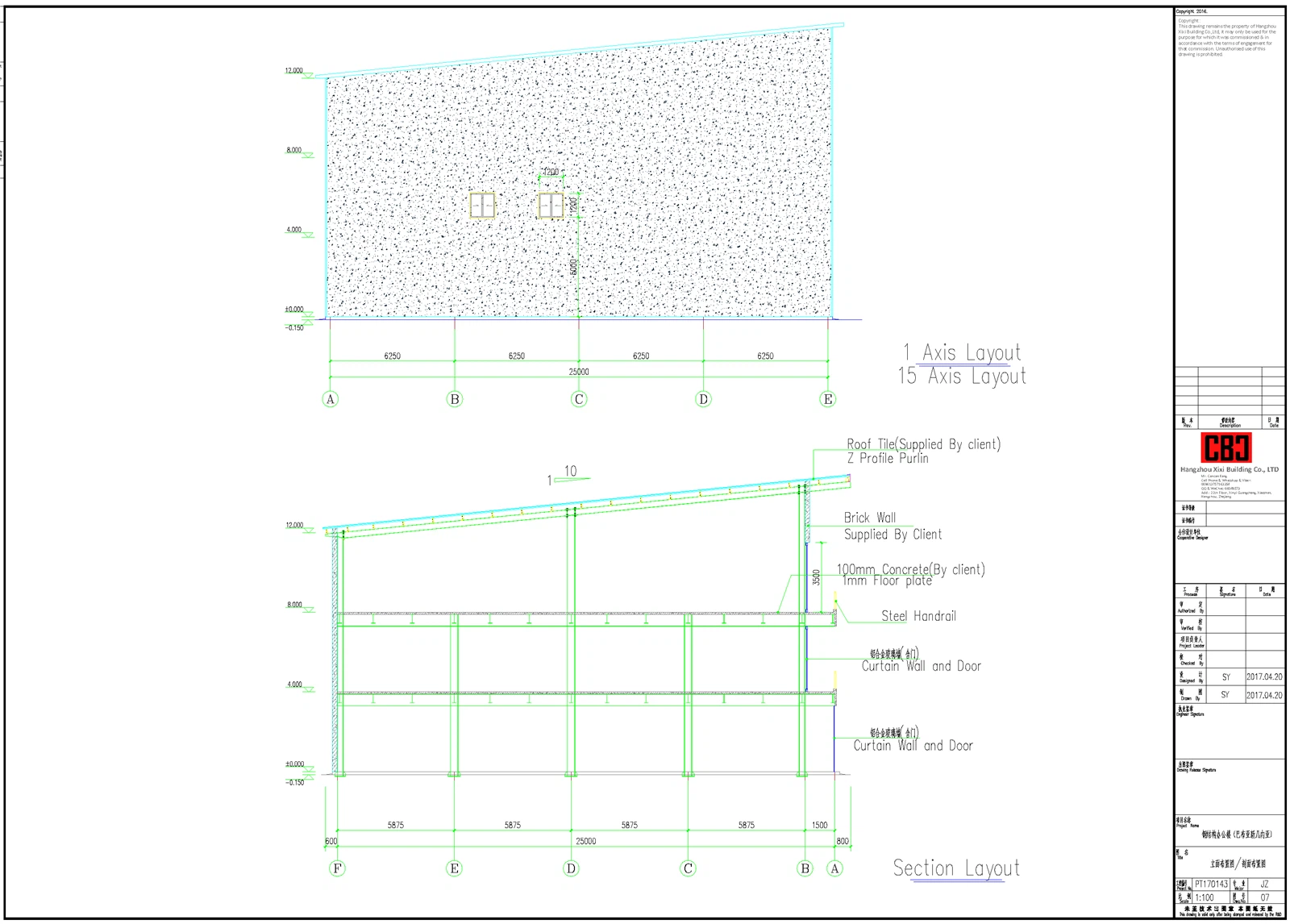
Width layout: Total width = 25.0 m, comprising:
1.5 m interior corridor along the south side,
23.5 m net office depth to the north.

Fenestration:
South façade: Full-height structural glazing (glass curtain wall).
North façade: Large fixed or operable glass windows (non-load-bearing).
Roof: Single-slope (mono-pitch) roof sloping northward (typical slope: 2–5%, assumed 3% → height difference = 0.75 m across 25 m span).
Eave height: Uniform clear height of 4.0 m at south eave; ridge (north edge) at 4.75 m.
Floor system: CBC-supplied 1.0 mm profiled steel deck (composite metal decking) with in-situ reinforced concrete topping (typically 100–120 mm thick), acting compositely with steel beams.
Walls: Non-structural infill using local hollow concrete blocks (not load-bearing; only for enclosure and partitioning).
Primary structural frame consists of:
Main transverse frames: Rigid portal frames or simply supported built-up I-beams spanning 25 m (clear span between north and south lines).
Longitudinal stability: Provided by roof bracing, wall bracing in toilet/stair cores, and diaphragm action of composite floor and roof decks.
Columns: CBC cold-formed or welded built-up columns spaced at bay intervals (5.71 m or 11.43 m), designed for gravity + lateral loads.
Q2: How is the structural system analyzed and designed under Papua New Guinea environmental conditions?
A2:
Port Moresby lies in a high seismic zone (PNG is on the Pacific Ring of Fire) and experiences tropical cyclones. Design follows principles aligned with AS/NZS 1170 and AISC 360, adapted locally.
Key design considerations:
Seismic loading: High seismicity requires ductile detailing. CBC frames should use moment-resisting connections or concentrically braced frames in stair/riser zones.
Wind loading: Basic wind speed ≈ 40–45 m/s (144–162 km/h). Glass façades must be structurally glazed with wind-rated mullions.
Roof drainage: Single-slope roof directs rainwater to north gutter; adequate fall (3%) prevents ponding.
Lateral stability:
South glass wall provides no lateral resistance → stability must come from:
(a) Braced cores in end bays (toilet/stair shafts),
(b) Roof X-bracing or diagonal ties,
(c) Composite floor diaphragm transferring lateral loads to vertical bracing.
Foundation: Shallow pad or strip footings on competent lateritic soil; pile foundations if near coastal soft deposits.
Structural software (e.g., ETABS, SAP2000) models 3D frame with:
Gravity loads: Dead (steel, concrete slab, finishes), live (3.0 kPa office + 0.5 kPa roof maintenance).
Lateral loads: Seismic (response spectrum per PNG codes) and wind (ASCE 7 or AS/NZS 1170.2).

Q3: What are the primary structural components and material specifications?
A3:
|
Component |
Specification |
|
Main beams (transverse) |
Built-up I-sections (e.g., 600–800 mm deep), plate flanges/web welded, grade S355 steel |
|
Secondary beams (longitudinal) |
C-sections or I-beams @ 2.5–3.0 m o.c. supporting metal deck |
|
Columns |
Box or I-shaped built-up sections, base-plated to concrete footings |
|
Metal deck |
CBC 1.0 mm galvanized profiled sheet (e.g., Bondek®-type), 120 mm concrete topping with mesh/rebar |
|
Bracing |
Circular hollow sections (CHS) or flat bars in end bays and roof |
|
Connections |
Bolted/welded moment or pinned connections per CBC standard details |
|
Cladding support |
Wall girts (C-sections) @ 2.0 m vertical spacing for brick ties and window anchorage |
Note: Hollow block walls are veneer only-connected via wall ties to steel girts but carry no structural load.
Q4: How would this design need to be adapted for the Philippines market?
A4:
The Philippines shares similar typhoon and seismic risks with PNG (NSCP 2015 governs design). Adaptations:
Wind: Increase basic wind speed to 250+ km/h in coastal areas → stronger roof anchorage, impact-resistant glazing.
Seismic: Higher seismic coefficients in Metro Manila (Zone 4) → enhanced ductility, possibly shift to Special Moment Frames.
Materials: Hollow blocks widely available; CBC decking compatible with local concrete practices.
Corrosion: Use galvanized or painted steel (Zinc-Al coating) due to high humidity.
Applicability: Highly suitable for industrial parks in Cebu, Clark, or Batangas. Minor tweaks to bay sizes may align with local module standards (e.g., 8 m or 10 m bays).

Q5: Is this design suitable for Chile and Peru? What modifications are required?
A5:
Chile and Peru face extreme seismicity (among the highest globally) but low typhoon risk.
Key adaptations:
Seismic design: Must comply with NCh 433 (Chile) or Norma Técnica E.030 (Peru). Requires:
Higher ductility class (e.g., Ductility Type D in Chile).
Strong column–weak beam hierarchy.
Base isolation or energy dissipation systems for critical facilities.
Wind: Lower than PNG (except coastal Atacama), so cladding loads reduced.
Glass façades: Must meet seismic drift limits (< h/400) to prevent breakage.
Foundations: Often require deep piles due to liquefiable soils (e.g., Lima, Santiago basins).
CBC system viability: Excellent-modular steel construction is growing in both markets for rapid deployment. However, local certification of CBC connections is essential.
Q6: How applicable is this design to Tonga, and what changes are needed?
A6:
Tonga is a small island nation with:
Very high cyclone risk (Category 4–5 storms),
Moderate seismicity,
Limited construction resources.
Adaptations:
Wind: Design for 280+ km/h gusts → robust roof tie-downs, missile-resistant glazing, or substitute glass with aluminum louvers + polycarbonate in non-critical zones.
Corrosion: Mandatory use of hot-dip galvanized or stainless steel fasteners and members.
Simplicity: Reduce architectural complexity; prefabricate entire frames off-island (e.g., in Fiji or NZ) for quick assembly.
Materials: Import hollow blocks may be costly → consider concrete tilt-up panels or fiber cement boards as alternatives.
CBC suitability: Good for government or NGO projects where speed and durability matter, but logistics must be planned carefully.
Q7: Can this building be deployed in South Africa? What regional factors affect its design?
A7:
South Africa has moderate wind/seismic loads but diverse climates (coastal Durban vs. arid Johannesburg).
Key considerations:
Standards: Design per SANS 10160 (loading) and SANS 10162 (steel). Seismic loads are low (most regions Zone 1), but wind can be high in coastal Western/Eastern Cape.
Security: In urban areas (e.g., Johannesburg), ground-floor glazing may require laminated or security film.
Thermal performance: North-facing glazing (in Southern Hemisphere) causes overheating → add external shading or low-e glass.
Materials: Hollow blocks and steel decking are standard; CBC system integrates well with local fabricators.
Corrosion: Coastal cities (Durban, Cape Town) need C4 corrosion protection.
Market fit: Ideal for commercial offices in industrial nodes (e.g., Rosslyn, Isando). Minimal structural changes needed.
Q8: Is this design appropriate for Indonesia? What adjustments are necessary?
A8:
Indonesia faces very high seismic and volcanic risk, plus heavy rainfall and humidity.
Required modifications:
Seismic: Must follow SNI 1726:2019 (equivalent to ASCE 7). High seismic zones (e.g., Jakarta, Bali, Padang) demand:
Redundant lateral systems,
Strict control of interstory drift,
Possibly dual systems (moment frame + braced core).
Wind: Moderate (except eastern islands), but monsoon rains require steeper roof slope (≥5%) and larger gutters.
Humidity & corrosion: Use Al-Zn coated steel (e.g., ZAM®) or paint systems rated for tropical exposure.
Local materials: Hollow clay or concrete blocks are common; ensure compatibility with steel frame movement.
Glass: Tempered, heat-soaked glass recommended to prevent spontaneous breakage in humid heat.
CBC applicability: Strong potential in Java, Sumatra, and Sulawesi for corporate or government buildings, provided seismic detailing is enhanced.
Conclusion:
The CBC steel-framed office building designed for Port Moresby is a robust, modular solution that can be effectively adapted to diverse global markets. While the core structural logic remains consistent, local environmental hazards (wind, seismic, corrosion), material availability, and regulatory frameworks dictate necessary modifications. With targeted engineering adjustments, this design offers a scalable, durable, and rapidly deployable office solution across the Philippines, Latin America, Pacific Islands, Southern Africa, and Southeast Asia.
You Might Also Like


Send Inquiry
